
No products in the cart.
A complete guide to pre- workouts
A complete guide to pre-workouts
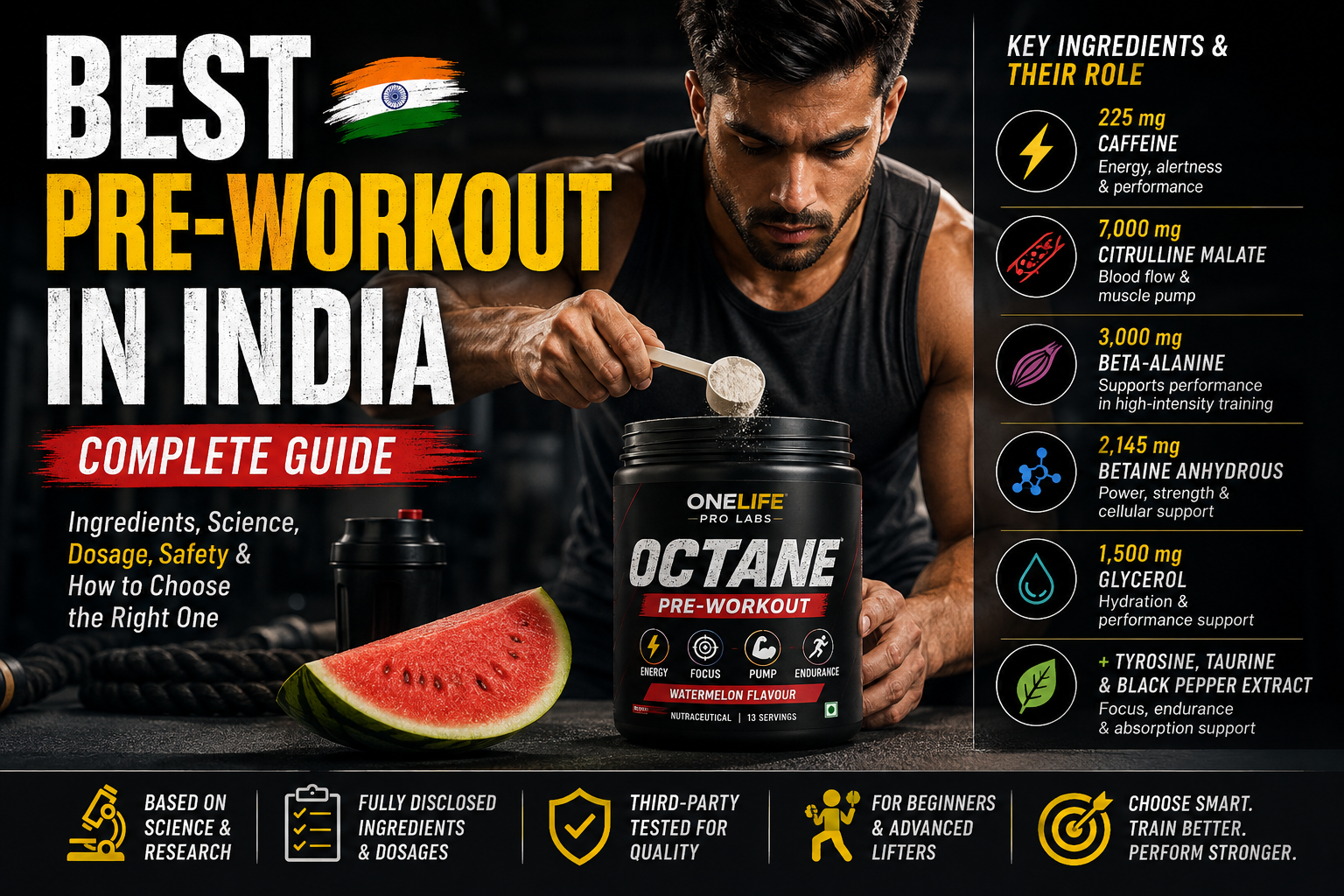
A pre-workout is a supplement taken before exercise to support energy, alertness, focus, blood flow, muscle pump, or training performance. Some formulas are mainly caffeine-based, while others combine a stimulant with ingredients such as citrulline, beta-alanine, betaine, taurine, tyrosine, and glycerol. The right choice depends on what you want from the product and how your body responds to it.
What Is a Pre-Workout Supplement?
A pre-workout supplement is designed to be consumed before a training session. Its ingredients may work through different pathways. Caffeine can increase alertness and reduce perceived effort. Citrulline is used in formulas intended to support nitric-oxide-related blood flow and the training pump. Beta-alanine is associated with muscle carnosine and buffering capacity over repeated use. Other ingredients may be included for focus, hydration, or broader exercise support.
The important distinction is between a pre-workout’s intended role and a guaranteed outcome. A supplement may help you feel more prepared to train, but it cannot replace a consistent programme or create muscle growth by itself. Training results still depend primarily on progressive overload, adequate food, sufficient protein, recovery, and adherence.
What Makes a Good Pre-Workout?
Caffeine: energy, alertness, and performance
Caffeine is one of the most researched ingredients used in sports supplements. The International Society of Sports Nutrition reports that caffeine can improve several aspects of exercise performance, with commonly studied doses around 3–6 mg per kilogram of body weight, although lower doses may also be useful for some people.[1] Individual response varies widely according to body size, habitual intake, genetics, sleep, and sensitivity.
For practical buying decisions, the label should state the exact caffeine amount per serving. It should also make clear whether caffeine comes from one source or several sources. A moderate dose may be more appropriate than a high dose if you train in the evening, drink coffee during the day, or are new to stimulants.
Citrulline: blood flow and the pump
Citrulline is involved in the body’s arginine and nitric oxide pathways. This is why it is commonly used in pre-workout formulas intended to support blood flow and the feeling of a muscle pump. Research on citrulline and citrulline malate is promising but not uniform: some studies report improvements in repetitions or exercise performance, while reviews also note methodological limitations and mixed findings.[2] [3]
A label that merely lists citrulline is not enough. The quantity and the form should be clear. In particular, readers should distinguish between a stated amount of L-citrulline and an amount of citrulline malate, because those labels do not necessarily represent the same quantity of pure L-citrulline.
Beta-alanine: a cumulative ingredient
Beta-alanine is not primarily an instant-energy ingredient. It is used over time to raise muscle carnosine, which may help buffer acidity during some high-intensity efforts. The ISSN position stand describes a modest performance benefit for exercise lasting roughly one to several minutes and commonly discusses daily supplementation of 4–6 g for at least 2–4 weeks.[4]
Some people experience a harmless tingling sensation called paraesthesia after beta-alanine. That sensation is not a reliable measure of effectiveness. A pre-workout containing beta-alanine should therefore be evaluated as part of a longer-term routine, not only by how intensely it feels immediately after consumption.
Betaine: possible support for power and training performance
Betaine anhydrous is included in some performance-focused formulas because it may influence cellular hydration and methylation-related processes. Research has explored its effects on strength, power, endurance, and body composition, but the evidence is less established than the evidence for caffeine.[5] It is best described as a supporting ingredient rather than a guaranteed performance enhancer.
Glycerol: hydration-related rationale
Glycerol can influence fluid distribution and has been studied in pre-exercise hyperhydration strategies. Some research suggests it may help retain fluid in particular conditions, especially heat or prolonged exercise, but results are not universal and the protocol, fluid intake, and environment matter.[6] [7] A product containing glycerol should not be marketed as a substitute for drinking enough water.
Focus-support ingredients and other actives
Pre-workouts may also contain ingredients such as L-tyrosine, taurine, or black pepper extract. Their intended roles differ: tyrosine is commonly included for focus, taurine for broader exercise and hydration support, and black pepper extract for formulation support. These ingredients should be judged by their disclosed dose and the quality of the overall formula, not by a long ingredient list alone.
What Does Science Say About Pre-Workout Ingredients?
The evidence supports a measured approach. Caffeine has the strongest and most consistent evidence among common pre-workout ingredients for acute exercise performance, but it does not work equally well for everyone.[1] Citrulline may support some aspects of resistance-training performance and the pump, although systematic reviews have found mixed outcomes depending on the form, dose, exercise protocol, and participants.[2] [3]
Beta-alanine appears more relevant to repeated high-intensity exercise after sustained use than to a single dramatic pre-gym sensation.[4] Betaine has potential, but the evidence base is smaller and the size of any benefit remains uncertain.[5] Glycerol’s most defensible rationale is fluid management in specific circumstances; it should not be treated as proof of superior performance in every workout.[6] [7]
This distinction matters because a credible article should separate mechanistic plausibility, study findings, and a product’s own marketing language. “May support” is often more accurate than “guarantees.” No pre-workout can guarantee muscle gain, fat loss, or a particular training result.
How to Choose the Best Pre-Workout in India
Use the following checklist before buying any product.
|
Factor |
What to look for |
|
Caffeine |
An exact amount per serving, not only “energy blend” |
|
Citrulline |
The exact form and disclosed quantity |
|
Label transparency |
Every active ingredient listed with its dose |
|
Testing |
Appropriate quality or third-party testing information |
|
Manufacturing |
Documented quality systems and credible manufacturing information |
|
Serving size |
A clearly stated scoop or serving weight |
|
Training goal |
Energy, focus, pump, endurance, or a balanced combination |
|
Tolerance |
A stimulant level appropriate for your experience and sensitivity |
|
Price |
Compare cost per serving, not only tub price |
|
Brand reputation |
Accessible contact information, product details, and traceability |
Avoid proprietary blends that hide individual quantities. Compare the amount of caffeine with your total daily intake from coffee, tea, energy drinks, fat burners, and other supplements. Also check whether the price is based on 13 servings, 20 servings, or a larger container; the apparent bargain may not be the lowest cost per workout.
Onelife Pro Labs Octane Pre-Workout
ONELIFE Pro Labs Octane Pre-Workout is a stimulant-containing pre-workout formulated for active adults who want a combination of energy, focus, pump, and training support. The current product pages list a 260 g container with 13 servings, which implies an approximately 20 g serving, and list Watermelon and Green Apple flavour options.[8] [9]
The current product-page formulation is as follows:
|
Active ingredient |
Amount per listed serving |
Intended role in the formula |
|
L-Citrulline DL-Malate |
7,000 mg |
Blood-flow and pump support |
|
Beta-alanine |
3,000 mg |
High-intensity exercise support over repeated use |
|
L-Tyrosine |
2,500 mg |
Focus-related formulation support |
|
Betaine anhydrous |
2,145 mg |
Performance and cellular-support rationale |
|
Glycerol |
1,500 mg |
Hydration and pump-related support |
|
Taurine |
885 mg |
Exercise and hydration-related support |
|
Caffeine anhydrous |
225 mg |
Stimulation and alertness |
|
Black pepper extract |
5 mg |
Formulation and absorption-support rationale |
The product page describes the formula as fully disclosed and states that it does not use a proprietary blend. Onelife also states that its batches undergo independent testing through Equinox Labs and that reports are shared on its third-party testing page.[10] Buyers should still review the current tub label and the specific batch documentation before use, because online product information, packaging, and prices can change.
At the time this article was prepared, the listed price for both flavour pages was ₹1,410 on sale, against a listed original price of ₹2,350.[8] [9] Based on 13 servings, the sale price is approximately ₹108.46 per serving, while the original price is approximately ₹180.77 per serving.
The strongest evidence-based reason to consider Octane is its disclosed multi-ingredient formula: the buyer can see the stated caffeine, citrulline-malate, beta-alanine, tyrosine, betaine, taurine, glycerol, and black pepper extract quantities. That transparency makes it easier to compare with other pre-workouts.
How to Use Octane
Follow the serving and mixing instructions printed on the current product label. The product pages state 13 servings per 260 g container, but the label remains the controlling source for the actual scoop size and preparation directions. As a general timing framework, stimulant pre-workouts are commonly taken about 20–30 minutes before training, while individual response and meal timing can shift that window.
If you are new to pre-workout, assess your caffeine tolerance conservatively rather than beginning with multiple servings. Do not combine Octane with another pre-workout, energy drink, caffeine tablet, or high-caffeine fat burner without accounting for the total. Mix it with the amount of water recommended on the label and maintain normal hydration during the session.
Is Pre-Workout Safe?
Safety depends on the formula, dose, frequency, and the person using it. The FDA states that up to 400 mg of caffeine per day is an amount not generally associated with dangerous negative effects for most healthy adults, although sensitivity varies and the figure is not a target that everyone should pursue.[11] Octane’s listed 225 mg caffeine per serving should therefore be counted alongside coffee, tea, cola, energy drinks, and other supplements.
Avoid late-day use if caffeine affects your sleep. Do not assume that a “crash-free” marketing claim guarantees a particular experience. Possible caffeine-related effects include restlessness, anxiety, palpitations, gastrointestinal discomfort, or difficulty sleeping. Stop using the product and seek appropriate medical advice if you experience concerning symptoms.
People who are pregnant or breastfeeding, have caffeine sensitivity, uncontrolled blood pressure, certain cardiovascular conditions, sleep problems, or relevant medical conditions should speak with a qualified healthcare professional before using a stimulant pre-workout. The same applies if you take medicines that may interact with caffeine or other supplement ingredients. A healthcare professional can account for your history, medication, and total caffeine exposure.
Can Beginners Use Pre-Workout?
Beginners do not need a pre-workout to make progress. Sleep, regular meals, water, technique, and a sensible training plan should come first. If a beginner chooses to try one, the first questions should be: How much caffeine does it contain? What else am I consuming today? What time do I train? And do I have any reason to avoid stimulants?
A conservative approach is more useful than chasing the strongest sensation. Start only when the product label and your personal circumstances support its use, and never treat tingling, sweating, or a rapid heartbeat as evidence that a product is working better.
Pre-Workout vs Coffee: Which Is Better?
Coffee primarily supplies caffeine, although its caffeine amount varies by bean, serving size, and preparation. A formulated pre-workout may provide a clearly stated caffeine dose together with ingredients intended for blood flow, focus, endurance, or hydration. That does not make it automatically superior.
Coffee may be sufficient for someone who wants familiar caffeine and does not need additional ingredients. A pre-workout may be more convenient for someone who wants a measured multi-ingredient formula. The better option is the one that fits your training goal, tolerance, budget, and sleep schedule.
Frequently Asked Questions
There is no universally best product for every athlete. Choose a transparent formula with disclosed quantities, an appropriate stimulant level, credible quality information, and a cost per serving that fits your budget. Octane is one option to evaluate if you want a listed 225 mg caffeine formula with citrulline-malate, beta-alanine, tyrosine, betaine, taurine, glycerol, and black pepper extract.[8] [9]
A beginner may not need one. If using one, choose a clearly labelled product and avoid starting with a high-stimulant formula or combining it with other caffeine sources.
How much caffeine should a pre-workout contain?
It depends on body size, sensitivity, habitual caffeine intake, training time, and total daily exposure. Research often studies 3–6 mg/kg for performance, but that is not a universal recommendation, and many people should use less.[1]
How long before the gym should I take pre-workout?
Many stimulant products are taken roughly 20–60 minutes before training. Follow the product label and account for how quickly you feel caffeine and whether you have eaten.
Is pre-workout safe?
It can be tolerated by many healthy adults when used as directed, but it is not risk-free. Review the caffeine amount, avoid stacking stimulants, and consult a clinician if you have a medical condition, take medication, are pregnant or breastfeeding, or are unusually caffeine-sensitive.
Can I take pre-workout every day?
Daily use is not automatically appropriate. Consider sleep, tolerance, total caffeine, and whether you can train effectively without it. Do not exceed the label serving or use it to compensate for chronic exhaustion.
Does pre-workout help build muscle?
It may help some people train with greater alertness or effort, but it does not directly replace resistance training, adequate protein, calories, or recovery. Muscle gain comes from the complete programme rather than from stimulation alone.
Does pre-workout help with fat loss?
A pre-workout is not a fat-loss solution. Caffeine may modestly affect alertness and exercise capacity, but sustainable fat loss depends on overall energy balance and diet. Avoid products that promise guaranteed rapid fat loss.
Is coffee better than pre-workout?
Neither is automatically better. Coffee may be enough for caffeine, while a pre-workout may offer a measured multi-ingredient formula. Compare caffeine, cost, convenience, and your tolerance.
What should I look for when buying pre-workout?
Check ingredient forms, exact dosages, caffeine quantity, serving size, manufacturing and testing information, brand contact details, price per serving, and suitability for your training goal.
Does Octane contain caffeine?
Yes. The current Octane product pages list 225 mg of caffeine anhydrous per serving.[8] [9]
How should I take Octane?
Use the manufacturer’s current label directions for serving size, water, and timing. The product jar contains 13 servings in a 260 g container. Take one scoop of preworkout mixed with approx 250 ml of water and take it before half and hour of your training.
You can also try the sample pack of Octane pre-workout by onelife prolabs just by paying Rs.150 for shipping and handling which you can claim back on your next purchase of full size Octane pre-workout
Final Takeaway
The best pre-workout supplement is not necessarily the strongest or most aggressively marketed. It is the one with a transparent label, sensible quantities, credible quality information, and a stimulant dose you can tolerate without sacrificing sleep. Onelife Pro Labs Octane is worth comparing on that basis because its current product pages disclose the main active ingredients and quantities, list two flavours, and provide public testing information.
sample pouches of Octane preworkout by onelife prolabs
References & Scientific Sources
[1] Guest NS, VanDusseldorp TA, Nelson MT, et al. “International Society of Sports Nutrition position stand: caffeine and exercise performance.” Journal of the International Society of Sports Nutrition, 2021. PubMed | Full text.
[2] Trexler ET, Persky AM, et al. “Acute Effects of Citrulline Supplementation on High-Intensity Strength and Power Performance: A Systematic Review and Meta-Analysis.” Sports Medicine, 2019. PubMed | DOI.
[3] González AM, Trexler ET. “Effects of Citrulline Supplementation on Exercise Performance in Humans: A Review of the Current Literature.” Journal of Strength and Conditioning Research, 2020. PubMed.
[4] Trexler ET, Smith-Ryan AE, Stout JR, et al. “International Society of Sports Nutrition position stand: Beta-Alanine.” Journal of the International Society of Sports Nutrition, 2015. PubMed | Full text.
[5] Cholewa JM, Newmire DE, Zanchi NE. “An overview of betaine supplementation and exercise performance.” Evidence reviewed in the sports-nutrition literature; see the PubMed review record and recent systematic-review evidence.
[6] Goulet EDB, Aubé S, Drapeau V, et al. “Physiological and performance effects of glycerol hyperhydration and rehydration.” Nutrition Reviews, 2008. PubMed.
[7] Jardine WT, et al. “The Effect of Pre-Exercise Hyperhydration on Exercise Performance, Physiological Outcomes and Gastrointestinal Symptoms: A Systematic Review.” Sports Medicine, 2023. DOI.
[8] ONELIFE Pro Labs: Octane Pre-Workout, Watermelon Flavour. Official product page accessed 21 August 2026.
[9] ONELIFE Pro Labs: Octane Pre-Workout, Green Apple Flavour. Official product page accessed 21 August 2026.
[10] ONELIFE Pro Labs: Third-Party Testing. Official quality-information page accessed 21 August 2026.
[11] U.S. Food and Drug Administration: Spilling the Beans—How Much Caffeine Is Too Much?, 28 August 2024.



2 Comments